Divány
From touch to understanding – 6 ways of bonding that accompany us throughout life

Attachment also develops through a process of growth. Dr Gábor Máté and his colleagues distinguish between six forms of attachment, which develop in sequence and become increasingly complex. This natural development can also be shaped and influenced by the child’s emotional maturity; for this very reason, it is worth keeping an eye on any changes in how it manifests itself.
When we talk about attachment, we usually think of the importance of the first year of life, as this is when that close, intimate and trusting bond between child and parent is formed, a bond that will then have an impact on the child’s entire adult life. However, attachment is not only important during this sensitive period. Dr Gordon Neufeld and Dr Gábor Máté The Strength of the Family In his book *[Title]*, he points out that our need for attachment accompanies us throughout our lives, precisely because it provides a point of reference.
It is a fundamental human need to be able to find our place in the world: to know who we really are, where we came from and why, what is real, what is good, why things happen and what their meaning is. Our relationships provide the foundation for this. A person’s greatest fear is feeling mentally or physically lost, and attachment seeks to prevent this by helping us find our bearings. For a child, the first such point of reference is provided by the relationship with their mother or primary carer. This is what we call early attachment, which is indeed crucial for the child; at the same time, attachment itself continues to shape their life, and as they develop, become more independent and expand their relationships, the nature of the way it manifests itself.
Six ways of forming attachments
For a child, the best point of reference is essentially a parent or another adult acting in the parent’s place (a teacher, carer or relative). However, this bond can be fragile and unpredictable, so its quality largely determines who becomes the child’s point of reference at any given time. In order to truly get to know our child and remain a suitable source of support for them as parents over the years, we need to discover and understand the nature and dynamics of attachment. Dr Gábor Máté and his colleagues distinguish between six forms of attachment, which develop in sequence and become increasingly complex. This natural development can, of course, be influenced by the child’s emotional maturity, so it is worth keeping an eye on any changes in how it manifests itself.
1. Connection through the senses
The earliest form of attachment favours physical closeness. For an infant, it is still important to sense the physical presence of the attachment figure (usually the mother) – whether through sight, sound, smell or touch. Due to the infant’s vulnerability, the adult’s presence provides a sense of security, so establishing and maintaining this bond is the most important task. If this sense of closeness is threatened in any way, the child also feels threatened and will try to do everything possible to eliminate the threat. Although this type of attachment is most pronounced in infancy, the importance of the sense of closeness does not cease in adulthood; it is simply re-evaluated. It is not this that will determine the quality of the relationship, but it continues to form part of it. The person to whom we are attached changes, and the extent to which this form of attachment manifests itself also changes – at least if we are sufficiently mature.
2. Connection through similarity
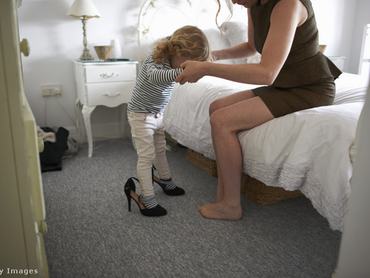
The next stage of attachment places great emphasis on imitating significant others and identifying with them. Even in two-year-olds, we often see a desire to adopt the characteristics of those close to them: dress, choice of words, activities, behaviour, and so on. „They try to imitate patterns of existence and expression, or to compete with them,” the authors write. Depending on the child’s age, the object of this identification may be a parent, a friend, a fairy-tale character, a role, a team, a country or even an idea. However, as a result of healthy emotional maturation, this type of attachment also loses its significance over time, as the child begins to yearn for relationships between equals.
3. Attachment through ownership and loyalty
The desire to possess, or feelings of jealousy towards a person or object with whom one is attached, also emerge in early childhood. Children need to feel the closeness, company and availability of whoever or whatever is important to them. This immature form of attachment is commonplace in nursery school (see who is friends with whom at any given moment), is relatively common and volatile in school too, but still occurs frequently even in adulthood. Possession is always accompanied by loyalty, which is a fundamental prerequisite for acceptance, particularly in the context of teams, circles of friends or personal relationships. At the same time, loyalty and possession also vary according to the degree and quality of the bond; therefore, this type of conformity can also be a good indicator of how a child feels about someone.
4. Bonding through a sense of importance
This kind of bond is considered a much more mature form of behaviour. It is essential for everyone to feel that they are important and valued in the eyes of others and in life. There are many ways to convey this sense of value. In childhood, this is most often achieved through words of praise and gestures of approval (smiles, sparkling eyes); children strive for this kind of feedback. However, this attachment also has its dangers, as it can make a child vulnerable: „A more sensitive child can easily be crushed if the eyes in which they seek signs of warmth and approval do not light up in their presence, whether those eyes belong to their parents or their peers.” – as stated in the book.
5. Bonding through emotions
The next stage is emotional closeness. It is this kind of bond that enables an individual’s sense of security not to depend entirely on the physical presence of the person who is important to them. Emotional connection can be accessed from anywhere, as we carry within us the awareness that we are important to the other person even when they are not present, even when we cannot see or hear them, and even when they are not available to us. This kind of attachment It already requires a great deal of maturity from both children and adults, as emotional attachment carries the risk that we may be deceived, exploited or emotionally broken. Emotional attachment runs at a deeper level, and many people (not just children) try to guard against this risk by clinging to a more superficial, primitive form of attachment.
6. Bonding through learning and becoming familiar with something
The final form of attachment is most likely to begin to emerge in a child around the time they are ready to start school. The sense of closeness in this form develops and strengthens more slowly, as getting to know one another takes time. This type of attachment is similar to sensory attachment, but the key difference is that it is no longer realised solely in a physical sense, but also on an emotional level. The child or adult feels „seen” and „heard”. They trust the other person enough to reveal their secrets and open up to them emotionally. Many people shy away from this, as in relationships of this nature – perhaps even as a result of a misunderstanding – the other person may appear to be rejecting them, which can instil fear, particularly if they have had bad experiences in the past.
Attachment is also a process that evolves over time. Although initial (early) attachment is highly significant for a person and can influence the course of this process, development does not have to stop there. By learning about the six styles of attachment, we can gain an insight into where our child is on this journey, and where we ourselves are on it. This realisation is needed if we are to serve as a source of support and guidance for our children – and perhaps for ourselves as well.
Originally published on: divany.hu, 25 November 2020.