
Divány
4 things to avoid when settling your child into nursery or pre-school

Starting nursery is quite a big change for every family, as it is the first time we entrust our child to what are, so to speak, strangers, which can bring with it a great many mixed feelings. However, our own attitude has a major influence on how well our child settles in, which is why we’re setting out what you should try to avoid to ensure a smooth transition.
The settling-in periods for nurseries and pre-schools are about to begin, which means the time has come for our child to step out of the familiar safety of home and try their hand at coping without our constant protective supervision. This is quite a big change for every family, as it is the first time we are entrusting our child to, so to speak, strangers, which can bring with it a great many mixed feelings. On the one hand, we know that they need company, the company of their own age group, and that they need to be surrounded by sufficient stimulation (opportunities for free play) during the day; yet, at the same time, letting go of their hand still causes us anxiety.
It’s easy to feel guilty about having to go back to work, or about wanting to. Sometimes we know it’s the right decision, but at other times we simply can’t imagine anyone else being able to look after our child properly. And with these conflicting feelings, settling our child into nursery is rarely a straightforward process. When we have to leave our child in the nursery room whilst they’re crying, or when they greet us in tears upon our return, it feels as though we’ve let them down. We worry about their physical well-being, but perhaps even more so about their emotional wellbeing and maintaining the bond of trust that has developed between the two of us.
Life at nursery and pre-school can, in general, have a great many positive effects on children’s physical and mental health. Ideally, it provides a wealth of knowledge, community It builds on children’s development at their own pace, whilst also providing a model for the next stages. And perhaps most importantly: under the right circumstances, it teaches children to trust both themselves and other adults, which is essential for confident independence, resourcefulness, emotional stability and good judgement of character. Our own attitude, however, plays a significant role in this matter, which is why we’re setting out what you should try to avoid in order to maximise the positive effects:
#1 Don’t let lies get the better of you!
During the settling-in period, we need to leave the nursery first for shorter periods and then for longer ones, so that our child can gradually get used to us not being there. Saying goodbye, however, can be tear-jerking for both of us, so we can easily fall into the trap of lying to our child („I’m just popping to the loo”), or, instead of saying goodbye, we might sneak out in the hope of avoiding their heart-wrenching sobs, which also break our hearts. However, this approach actually undermines the trust between the two of us, which in the long run could affect their future adult relationships. Even if it hurts at first, it helps your child if you’re honest and use this to prepare them for what’s to come. If they know in advance that you’re going to be away, and also when you’ll be back. If they can truly trust your word, because, just as you promised, you were there after lunch, or you arrived whilst they were playing in the playground after their afternoon snack. If they can trust you, they will trust themselves too, and everyone else they can truly rely on.
#2 Don’t be afraid of crying!
Naturally, we don’t want to see our child crying, as this only makes us feel even more that we are letting them down when they are in trouble. At the same time, crying does not necessarily have to be seen as something to be avoided at all costs.
Crying is a natural way of releasing tension, which prevents children from suppressing their negative emotions.
And that’s very important. It also shows that they feel a bond with you and are willing to express it. What’s more, there may be another benefit. It gives the teacher the opportunity to connect with the child, to build a relationship of trust as soon as possible (not the same as the one with the parents), so that the child can soon feel safe. Of course, this also means we need to trust that our child is in good hands. We can even tell them that if they’re scared, sad or homesick, they should go to Auntie Terka – she’ll definitely reassure them. If our child sees that we, too, trust their carers, they’ll settle down and adapt more quickly.
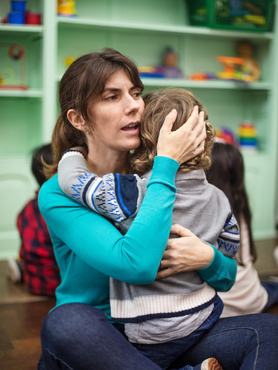
#3 Don’t make a long farewell!
For a child, the most important thing is for the events in their life to be as predictable as possible. The frequent back-and-forth surrounding saying goodbye is ineffective precisely because it perpetuates uncertainty and false hope in the child. In contrast, rituals can be of great help. No matter how long a goodbye takes, if it is part of a ritual with a clear sequence and a clear closing phrase, it makes the child feel secure, and so they will leave on their own after a short while, once they have waved goodbye to you.
#4 Don’t think he’s ignoring you because he hates you!
Once the settling-in period is over, it’s quite common for a child not to want to go home. Often, even if a parent arrives in a hurry, expecting their child to throw their arms round them, they find themselves faced with quite the opposite reaction. The little one carries on playing, appearing not to take any notice of their beloved parent’s arrival, or their meeting might even immediately descend into an argument. Don’t think this means you’ve ruined everything! It may well be that they’re trying to punish you a little with their behaviour, but this is simply due to frustration arising from their childish helplessness (they’re not the ones in control).
With the right emotional support (see the points above), your relationship won’t change. All they want is for you to pay a little attention to them right now, and for you to take the time to reconnect rather than rushing off straight away. This isn’t always easy when we’re also keen to get home, and the circumstances at the facility mean we’re expected to leave, but the key is to understand this need. Don’t misunderstand them or become uncertain, as this will also unsettle the child’s emotional state; instead, show empathy and acceptance! The same principle applies here: if you are confident that your decision is the right one, they will have no particular reason to doubt it either, and will be able to to adapt.
Originally published on: divany.hu, 12 July 2021.