Divány
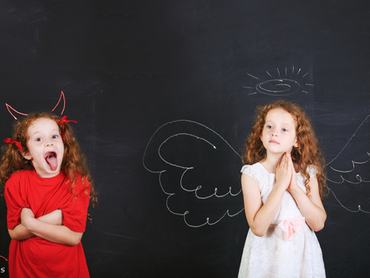
The child is an angel everywhere else, but a real little devil at home. Why?

Children’s behaviour reveals a great deal about their relationship with their environment, though often in a paradoxical way. For example, the tensions they direct towards us are not always a sign of hostility – in fact, they often reflect the sense of security we provide.
As adults, we choose what image of ourselves we present to different people. We often make a conscious effort to shape our appearance and behaviour in order to make the right impression in our current surroundings. We want to be accepted quickly, for people to form a positive impression of us, or perhaps even for them to recognise our virtues and good qualities straight away. Perhaps, to an outside observer, this behaviour does not seem particularly moral, but from the perspective of how the human psyche works, it is natural. One aim of self-regulation is self-protection, which may take the form of asserting oneself, but may also involve avoiding conflicts.
Just like adults, children don’t always present the same image of themselves to everyone. Even the very youngest children may behave like little angels at nursery or pre-school, whilst at home they are proper little devils – or it may be the other way round – though they usually do so for different reasons. Their good behaviour is not merely for show. Just like most adults, children let their guard down and show less self-control in places where they feel safe – which, ideally, is the warmth of home and their parents’ unconditional love. At the same time, it is hard to believe that the aggressive, angry, disrespectful and cheeky behaviour we receive in response to our devotion is not directed at us or about us. Even if we are aware of this, we do not feel honoured by such behaviour, so it is no wonder that we find it difficult to decide how exactly let’s respond.
Out there in the big wide world
Children face a great deal of stress on a daily basis, as the world is full of phenomena that are new, unfamiliar and unpredictable to them and events. The less we know about how the people, objects, living beings and situations around us function, the greater our sense of uncertainty and vulnerability, and this prompts us to heighten our attention, self-control and adaptability. And children, however young they may be, strive to do just that. This is one of the reasons why they may appear more obedient and cooperative in nurseries, kindergartens and other institutions – after all, for their own safety, they have to adapt to some extent.
They are bombarded with a huge number of stimuli, which they are still only just trying to perceive, manage and process properly, and this takes a great deal of energy. Perhaps even as adults, we sometimes feel that the more concentration we need during the day, the more easily our „stress tank” fills up. When a person has to focus for long periods, pay attention and control their own emotional responses, they try to suppress, brush aside or put aside less significant sources of stress and fatigue. At least for as long as they can. That’s why it’s so good, when you’re away from work, to do something where these pent-up feelings can be released. It could be sport, having a drink with friends, some kind of pampering treatment, or anything else that helps you switch off, unwind and feel free.
But what about the children who are not yet able to express what they want – or, indeed, what has upset them – and from whom adults still expect to behave and obey their every command? They become exhausted, and yet they are unable to communicate any of this, or to deal with it appropriately.
Where there’s safety, there’s relaxation
Even in the adult world, it is often the case that we take out the tensions that have built up during the day on our family members at home. Why? Because at home we feel (or would like to feel) safe, where we are listened to and accepted. Children, too, generally let their guard down where they feel their parents’ constant love and acceptance – in other words, it is precisely as a sign of our good relationship that we end up on the receiving end of their anger.
It’s a strange paradox, but this is often the reality, and it’s not easy to cope with or stand your ground in such situations. We can easily take our child’s negative behaviour personally, and start to doubt whether we’re bringing them up properly or whether we deserve to be treated this way. Of course, we also need to ask ourselves whether this is really about us or not. We expect teenagers to be disrespectful and cheeky, but we do not yet expect this from young children, and it is often unclear from their communication what might have triggered the hostility. That is why we need to approach conflicts with patience and attention, even whilst dealing with our own everyday difficulties.
We need to be able to distinguish the child’s behaviour from our own, so that we don’t immediately start to defend ourselves, even if strictly, or even with leniency, but to help them express themselves. This is a serious task that requires awareness and practice. It is up to us to help them put their feelings into words (‘Are you angry? Did you expect…?’), or perhaps to find a way for them to express those feelings in an acceptable manner (through talking, drawing, withdrawing, or screaming into a pillow), whilst also respecting each other’s boundaries.
Maintaining reasonable boundaries is not a lack of tact
Whilst the emotional strain a child experiences at home does require understanding on our part, it need not go hand in hand with overturning the values and boundaries we hold dear. When we see that our child is going through a difficult time, we tend to become overly lenient, and in order to protect and support them, we often compromise on our own boundaries, hoping that our devotion will be reciprocated. However, blurring these boundaries can lead to a number of problems, as this situation is not sustainable in the long term. If we do not protect our own personal space, we can quickly become exhausted, and feel more stressed and tense, which can in turn cause our child to feel distrustful and insecure. They won’t know what to expect or for how long, which may cause their tension to increase further rather than ease.
In such cases, they are effectively left with two choices. One is to become quiet, withdraw into themselves and start to feel somewhat anxious even at home; or, conversely, to intensify their defiant behaviour in an attempt to push the boundaries. These cries for help are usually very intense, attention-grabbing, and indicate that the child craves predictability and security.
When there’s an angel at home and a devil elsewhere
Children usually really show their true colours to their parents, as it is from them that they can expect a secure attachment the greatest understanding and acceptance. However, it may happen that the situation changes, and others report behaviour that we never experience at home. In such cases, it is worth looking into the context in which the unwanted behaviour occurs and towards whom it is directed. The more personalised or location-specific it is, the more likely it is that a bad experience or relationship lies behind it, which has caused the child anxiety or frustration, and they are now trying to protect themselves through this change in behaviour. Conversely, the more the behaviour becomes generalised outside the family environment, the more likely it is that the cause lies at home, as for some reason the child is only able to keep their internal tensions under control at home.
Children’s behaviour reveals a great deal about their relationship with their environment, though often in a paradoxical way. To truly understand them, we need to step back from our own perspective and try to assess them as an outside observer. To do this, we will need patience, openness and, above all, perseverance.
Originally published on: divany.hu, 8 October 2020.