
Divány
An imaginary friend is a sign of a child’s mental well-being

Children still confuse the imaginary world with reality. They embellish what has happened, and sometimes talk to imaginary creatures or people. But for how long is this considered normal?
An adult who daydreams a great deal and is unable to distinguish between reality and the imaginary world is considered to be disturbed and a clinical case. With children, however, the situation is different. For them, the boundary is initially blurred, and right up until primary school age they easily jump from one side to the other. They do not use their imagination merely for entertainment or play; their imaginary world provides a means of finding answers to questions they cannot yet articulate, of living out their desires, and thereby of resolving their inner tensions. Daydreaming offers support when and where they need it – in ways that their environment is currently unable to provide.
A bold imagination
It is easy to assume that children have a more vivid imagination than adults. However, this is by no means the case. We build our imaginations on our own experiences, adventures and memories, of which we have far more than our children do. Their imagination only seems richer because they use it much more boldly. They are not yet as attached to reality as we are, so they mobilise their imagination more boldly and daring to make up for their gaps in knowledge and to bring their impossible desires to life. They embellish their stories because they are searching for connections and explanations that make sense to them. They anthropomorphise their soft toys, or create a being that is completely invisible to us, because they need someone who understands and accepts them, and who is there only for them their rules of the game plays according to the rules.
The imagination as a channel
For children at the beginning Not only is the world around them unfamiliar, but so too are their own bodies and minds. Their intense emotions sometimes frighten even themselves. They are unable to make sense of these impulsive feelings, let alone know how to deal with them. Their still-developing communication skills mean they are largely unable to express their inner anxieties, frustrations and questions in a way that the adults around them can understand; they are, so to speak, left to their own devices. Daydreaming helps them in this regard. It forms a bridge between their experiences and the reality of being human. Like a walking stick, it accompanies them on their journey to adulthood, adapting to the sometimes bumpy path to provide the right support when it is needed. It offers a helping hand in the face of the unknown, fears and expectations. This mediating role of the imagination is essential for healthy development.

The dimension of the imaginary friend
A century ago, research The presence of imaginary friends in children’s lives is still often described as a negative phenomenon. It is therefore not surprising that many of us remain concerned to this day when we notice our child talking to thin air and clinging to the company of this imaginary being. However, this expert view has changed considerably since then. Whilst studies carried out in the 1930s referred to the phenomenon as a problem, the the current state of science is, in fact, a sign of good and creative mental health. We now know that daydreaming is not just a means of relaxation and entertainment, but plays a wide-ranging role in children’s overall development. An imaginary friend can be a personified soft toy or a being that is completely invisible to us. It usually embodies traits, characteristics and situations that the child is grappling with emotionally. An imaginary friend indirectly helps the child to come to terms with reality. Through them, the child is able to experience their fears and desires, receive answers to their questions, and learn to accept themselves and the situations they face in life. They maintain the child’s sense of security even when their environment is unable to do so.
When does it become a problem?
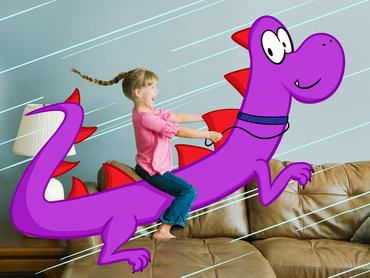
The emergence of imaginary friends is most common during the pre-school and early primary school years, although it can also occur during adolescence and adulthood. In the latter two cases, too, it can be considered entirely normal provided that the individuals are aware that their friend is not real, but a figment of their imagination. In fact, even younger children are usually aware of this, and many are actually quite proud of their vivid imaginations, as this allows them to have complete control over the character they have created. The imaginary friend plays exclusively by their own rules. They do not have to obey adults, take the laws of the world into account or live up to expectations. They can do things that the child cannot do in the real world. An imaginary friend relieves inner tensions, helps find answers to questions that arise, protects against loneliness, and can be completely independent of the circumstances of current reality. Such a friend can only be a gift to a child’s soul.
A supporter of progress
A child’s imagination does not merely provide the necessary support in the face of emotional difficulties. It also plays a significant role in children’s personal, intellectual and social development. The personal traits they project help children to get to know and accept themselves. And, as we know, positive self-esteem and self-worth are fundamental to a happy life. Furthermore, the child’s social skills also develop through their relationship with an imaginary friend. As the personified character reflects the child’s own feelings, this makes it easier for them to learn and apply the ability to empathise. This can be of great benefit to their future healthy social relationships. As for the positive effects on cognitive development, this is hardly news. Frequent daydreaming develops creativity, an understanding of cause and effect, the ability to solve problems independently, and promotes a free-thinking mindset – all of which are, once again, essential for achieving success.
Parental attitude
We might find ourselves wondering: Will my child grow up to be a loner, or someone who always has their head in the clouds? Daydreaming is a natural part of a child’s life, so we needn’t fear any negative consequences as long as we, as parents, take the right approach to the matter. Our feedback is, after all, very important to our children. If we reject their own means of self-expression and their own way of solving problems, they will withdraw from us, which may have a negative impact on their healthy psychological development. Imaginary friends remain a part of a child’s life for as long as their soul needs them, and that is perfectly fine. Our world is full of unexpected challenges, and it would be impossible to shield our children from everything. Let us be grateful for an imaginary friend, as it simply shows that our child has well-developed creativity and the ability to solve problems independently, and is therefore able to experience their emotions! They manage to provide support for themselves when neither we nor those around them are currently able to do so.
Let’s feel free to play an active part in the process! Let’s be open-minded and accepting! Let’s show our child that we believe in them and are grateful that they are sharing their private world with us! Let’s join in their play, whilst allowing them to take the lead. Let’s play by their rules, as this is the world He knows it better, and that’s certainly how it should be!
Originally published on: divany.hu, 27 May 2020.