Divány
Don’t try to force the moral of a story down a child’s throat – it doesn’t work that way

Fairy tales offer children the opportunity to resolve their inner, unspoken and unarticulated tensions. However, this can only happen if they are in control. The story retains its magical and healing power until the listener achieves emotional freedom. They identify with whomever they wish and interpret the plot in a way that their heart needs at that moment.
For our children, stories (by which we mean made-up or read-aloud stories) are not merely a form of play or relaxation, but an activity that also involves a kind of mental work. They serve as a tool, a crutch, which helps them understand how the world works, the meaning of the stimuli they encounter, and how to process the events taking place within them, all in their own language. It is no coincidence that there is so much talk these days about the importance of storytelling, yet there are still many misconceptions surrounding the subject: ‘They’re brutal, far too detached from reality, they make no sense, they set a bad example’ – this is what some people say about stories.
The fantasy world embodied in fairy tales is, in many cases, indeed far removed from our adult worldview and way of thinking. We do not recognise in them the symbolism or the values they convey, which are – albeit subconsciously – obvious to our children. Indeed, it is precisely this unspoken nature, this lack of concrete interpretation, that can provide a sense of security and emotional reassurance, as the conscious recognition of their feelings and having to confront them might well frighten them. Their intellectual development is not yet ready for the monotonous and unambiguous conclusions and explanations provided by logic and rationality; on the contrary, it is free imagination and symbolism that can create the shield their souls need at that particular moment.
So, if, as adults, we want to open a child’s eyes to the meaning and moral of a story’s plot, we are in fact shattering this very invisible shield. Whether we are talking about folk tales, therapeutic stories, or any other form of modern children’s literature.
It is imagination that protects children from the horrors of reality
Children are still able to move freely between these two dimensions. They constantly observe their surroundings and the physical and emotional processes taking place within themselves. Some things make sense based on their knowledge of reality, whilst others do not, so they call upon their imagination. For the mind, ignorance and uncertainty are more frightening than a departure from reality. Children therefore often need to step into the world of fantasy in order to feel safe in a reality that is dominated by adults and is still new and complex to them.
A joint and good storytelling allows us to enter a dimension where everything is predictable: it is clear who is good and who is bad, that the path always leads through trials, and that, in the end, the one who would be least expected to triumph will prevail. They bring to life and shape the characters through the powerful forces and emotions that exist within a child, but which, if recognised in reality, would paralyse them. In fairy tales – particularly folk tales – fear (the dragon, the youngest son), anger (tearing to pieces), jealousy (fratricide), the duality of parental behaviour (fairy, witch, hunter, wolf) or the child’s self-confidence (helping animals). Those feelings and traits which are simultaneously characteristic of human beings are separated in children’s imaginations, and in this way they take on meaning and can thus be overcome.

The story gives them the opportunity to come to terms with their anxieties and their mixed feelings (I love – I hate Mum). In this world, they are given the space to experience those feelings which are socially unacceptable, feelings which in reality would provoke aversion or rejection from their loved ones – and thus from themselves as well. Here, in the world of the story, it is therefore up to them to to direct, because only they know what their souls need.
It is always the child who chooses the moral of a story
The importance of stories – alongside free play and drawing – is particularly significant in helping children process their inner tensions. Ever since this was highlighted in academic research, numerous storybooks have been published on topics that seek to offer solutions to common conflicts affecting children. We find storybooks about potty training, the arrival of a new baby sibling, the on passing away, about pickiness, settling into a new routine, fears, making friends – and we could go on listing the countless conflicts that children have to face.
These stories tend to stray less frequently from reality. They are often written in the language (and mindset) of adults, as they are realistic and down-to-earth, and are primarily intended to offer us reassurance, a sort of anchor against our worries, for it is our hope that there will be no sibling rivalry, that there won’t be too much crying at parting, and that we won’t have to beg our children to eat. We place our hopes in these stories, hoping they will open our children’s eyes to how good all the things they reject actually are. If we do choose a good book that is close to reality, yet captures and acknowledges a child’s joys and sorrows, then of course these books can also be of help to us, but for this to happen, the child must genuinely enjoy it and ask to read it again and again, or look at it repeatedly, without us forcing it on them.
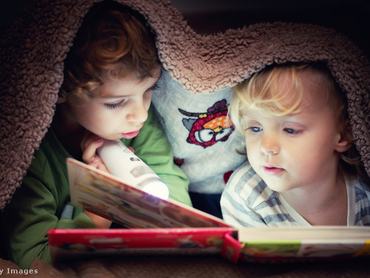
However, the magic of stories is lost if an adult takes control of them. They lose their healing power if we spell out the moral for the child, and the child is unlikely to ask for them again. A fairy tale offers spiritual freedom; the listener identifies with whomever they wish and interprets the plot as their heart desires. We, as parents, must not interfere with this, even with the best of intentions.
It doesn’t matter what story we make up or read aloud to our child, as long as we feel they’re enjoying it. They’ll ask for that one anyway. All we can do is give them the chance to choose. It’s best to have a mix of folk tales, modern children’s literature and stories we’ve made up ourselves, so that they can always reach for whatever feels most like their own at that particular moment. These stories (unlike certain animated films) do not encourage them to be aggressive or out of fear, but they teach them how to process these naturally arising emotions in the right way.
Let us be the their partner! They do not need the moral of the story to be spelled out. Let us not take away the magic and healing power of fairy tales! Let the children take the lead there! As for us, let us be observers, instruments who accept the hidden struggles of a child’s soul, and respond only to the questions that arise within them.
Originally published on: divany.hu, 3 February 2021.