Divány
A child’s speech will not develop through talking toys
Interaction is essential for children’s language development. The more they are exposed to human speech, singing and storytelling during their early years, the more effective their learning abilities are likely to become by the time they start school.
The first three years are crucial in our children’s lives. They learn more during this time than they ever will again. Early experiences shape and lay the foundations that will subsequently determine their future attitude towards the world. Whether we’re talking about values, social skills, self-awareness, communication or knowledge itself. Providing the right support for these is achieved through the combined power of parental behaviour and communication. Movement and language have been closely linked from the very beginning. Although linguistic development only begins to show noticeable results later on, it actually starts in the womb – and this is important because it is our communication that truly makes us human. Although there are animal species that can be taught human language, there is no other species that needs this means of communication to the same extent as we do. And the quality of the developmental process of speaking, writing and reading – which is unique to us – can have an impact on our entire lives.
Communication is more than just speech
Language development begins whilst the baby is still in the womb. Our expanding abdominal cavity acts as an excellent sound amplifier, so that external and internal sounds (heartbeats, gentle stroking, the sound of speech, laughter) quickly become familiar to babies. These familiar sounds create a sense of security, which is always a fundamental prerequisite for learning. A parent’s communication plays a decisive role in a child’s development and should not be confused with the importance of speech in the narrow sense. Many of us try to support our child’s language development by with talking toys surround them, or something of an „educational nature” TV programme We sit them down in front of it. But they won’t be able to learn from this. Children’s language development requires interaction. The sort of communication in which a genuine connection is established between the parties, who look at one another, touch one another and respond immediately (through body language and spoken language) to the other’s expressions. Language forms a bridge in our human relationships; therefore, we also need human relationships in order to acquire it properly.
Poverty does not have to be a disadvantage
These days, we are becoming increasingly cautious about joining the ranks of those starting a family. We make plans, do the maths and try to prepare ourselves. We want our children to want for nothing and not be at a disadvantage compared to their peers. But who knows when, or what, will put them at a disadvantage? Toys, clothes, parental prestige, sport or knowledge? Betty Hart and Todd R. Risley’s highly popular 30 Million Word Gap entitled *(A Gap of 30 Million Words)* his study This highlights just how important children’s communication experiences during their first three years are. The researchers felt that institutional support was not effective enough in mitigating the educational disadvantages faced by children from poor backgrounds, which is why they wanted to investigate the period before the age of three. The results of their research showed that the development of these disadvantages was unrelated to either poor-quality care or a poor material background (quantity of toys, living conditions). It was, however, linked to the quality and quantity of interactions between parent and child.

Children learn words through us. Initially, their passive vocabulary (words they understand but do not use) expands based on their observations: they watch what words we use, when we use them and for what purpose, as well as how we form them. They watch our mouth movements, facial expressions and gestures, whilst also listening to the associated rhythm and intonation. The words they hear, in turn, form new connections in the brain. They do not need to repeat them, nor do the words need to make immediate sense to them in order to be stored. All they need is to encounter these expressions as often as possible and in a variety of contexts, which strengthens and consolidates the nascent neural connections. This high-level information processing is unique to the first three years of life and gradually loses its effectiveness as the years go by; this is why language learning becomes so much more difficult in adulthood. The more human speech, singing and storytelling our children are exposed to during this sensitive period, the more effective their learning abilities can become by the time they start school. As parents, we set the example for our children first and foremost, which means that our own vocabulary and communication skills will also influence their language development. However, all we need to do is be bold talk to them, to sing and read to them.
Language enrichment
Dr Brenda Fitzgerald’s 2014 TEDx-in his speech language nutritionShe referred to communicative interactions with babies and young children as ‘linguistic nourishment’. Language plays an important role in brain development, as it is a key factor in all human learning processes. Language development leads to speech, literacy and reading skills, which lay the foundations for later academic achievement and, subsequently, professional success. Children learn to read at school by the age of 8 or 9. According to Fitzgerald, this is a crucial time in terms of further development, as the sequence changes from this point onwards: whereas up to this point they have been learning in order to acquire the ability to read, from now on they will learn new things precisely through reading. Those who fall behind at this stage will face serious difficulties in catching up. Therefore, it is never too early to begin nurturing language skills, which will form the basis for academic and professional success. Even our interactions during pregnancy (talking, cuddling, singing) support our child’s development, as do our later bedtime stories, nursery rhymes and conversations about discovering the world. These early experiences enable our children to open up to the world and gradually prepare themselves for the demanding expectations of school.
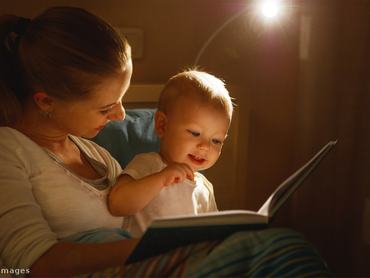
Although children’s brains are most active in the early years, it does matter how we seek to make the most of this. Many of us, in our eagerness to cram as much knowledge as possible into our children’s heads at an early age, plan a constant stream of extra lessons and structured activities into their daily routines. However, it is worth being careful with this. During the early years, the focus is not only on acquiring knowledge, but also on strengthening a secure attachment. Spontaneous moments spent with us matter to them. Even simply making funny faces together in the baby carrier, or having our understanding and reassuring response to their crying her consolation or the playful songs sung whilst changing nappies also strengthen the sense of togetherness. Later on, at their request, the story was told again and again our stories, the new experiences we share and discuss during our travels – and, not least, our quest for answers to their endless ‘whys’ – continue to broaden their horizons. These moments shared with us all support their development. Our openness, our willingness to respond and our active presence create a safe environment for them, in which they will dare and want to learn new things. Time and time again.
Originally published on: divany.hu, 28 July 2020.