Divány
8 basic rules: how to play with your young child!
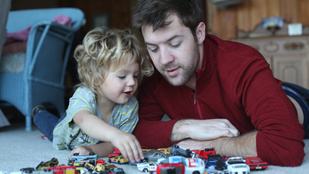
For children, play is not just a form of relaxation, but also a way of learning about themselves and the world around them. Our role is not to direct or teach, but to participate in a supportive way.
Play is the most characteristic form of activity in children’s behaviour. We adults tend to underestimate the importance of play, defining it simply as a form of recreation. However, it plays a far more important role in young children’s lives, as it is closely linked to their physical, emotional, intellectual and social development. As time goes by, the nature and function of play also change in line with this. Through play, young children become familiar with their own bodies, minds and spirits, as well as with the workings and boundaries of the world around them. To ensure this can truly take place, always bear in mind the following 8 rules when playing together!
#1 You don’t need many toys, but they should be multifunctional
From the time our children are babies, we tend to accumulate more and more toys. We can surely list many expensive gifts which, after just a few weeks, no longer held our child’s attention at all. One reason for this may be a lack of imagination, in which the absence of parental role modelling can play a major part. Another common reason is when a toy is too specialised, meaning it cannot be used for anything other than its intended purpose. The simpler a toy is, the more versatile it becomes. A couple of wooden block, a Duplo brick or a train track can symbolise building materials, a road, a telephone, a remote control, a sandwich, or even a hammer. By contrast, a large plastic turtle with three buttons on its back, for example, is much less likely to represent anything other than a turtle. Of course, it is we who can initially demonstrate the use of these symbols to our little ones, thereby launching them into a world of imagination that will support not only their personal development but also social learning.
#2 Play should always be spontaneous and voluntary!
For children, any activity can be a game, and any experience can turn into a game. They are still able to see the magic in everything. They don’t even need specific toys. For them, every situation offers a wealth of possibilities for them to explore. Play is triggered by an instinctive, inner urge, a kind of curiosity. A curiosity about how things work and what they can be used for. Unlike adults, for younger children the focus is not yet on achieving a pre-defined goal, but on the experience of discovery itself. They long to experience things first-hand. Whatever happens (as long as there are no accidents), they’ll feel a sense of achievement.
Play should therefore always be spontaneous and voluntary. We can offer options, but the decision should always be the child’s! If we don’t stick to this, it won’t be real play, as the joy of discovery itself will be lost.
#3 Only get involved if he asks you to!
The presence of parents (or trusted adults) is important for children. It is through them that children feel safe. On the one hand, if their need for security is not met, this can prevent them from becoming fully immersed in play; on the other hand, however, in many cases they do not actually need us to participate in their play. During adult-free play, they are able to let go of their desire to please us, allowing them to express and process their emotions, thoughts and experiences without any particular constraints. So sometimes, all they need is to feel that you are there, nearby. However, you should only take an active part in the play if your child asks you to.
#4 Be there!
Whether you’re simply there as a distant observer or take centre stage in your child’s play, each role has its own place in their development. However, your mere physical presence won’t be enough for your child if your thoughts are completely elsewhere. Their brains are extremely sensitive; they pick up on much smaller cues than your fully developed mind does. If we simply need to create a safe environment for the little one, then of course this is not as important as when we actively take part in the play itself.
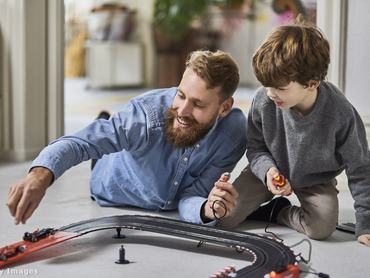
Children feel a constant urge to attract their parents’ attention – to feel seen, heard, understood and valued. This also helps to build their self-esteem. However, if our minds are preoccupied with the logistics of getting through tomorrow, or we’re fretting that we still haven’t put together yesterday’s presentation – and that’s why the boss gave us a frown today – then our physical presence means nothing to the child. It’s no good for them, and it’s no good for us either. Letting go of the past and the future, even for just half an hour, whilst we play with our child, is a gift for both of us. We, too, can enjoy the carefree nature of childhood, and our child can feel important.
#5 Don’t lead, just follow!
When playing with our children, we can almost imperceptibly take control. We immediately start giving advice or judging their thoughts and solutions. We are not driven by malice, just by habit. But this means the game loses its other essential element: free self-expression. In many areas of life, our children have to submit to the demands of adults. In order for their self-regulation system to develop later on – that is, for them to learn to control themselves – they need a space where they are in charge. A place where they can test their limits, process their experiences and practise the behavioural patterns they consider important.
The game takes place in Neverland, where there’s no difference between adults and children. There, even a child can be our boss. Hand over control – as long as it’s not dangerous! They invite us to join in, they assign the tasks, they direct the action, they define what things mean, and they decide when it’s over!
#6 Let your imagination run wild, and let the child make mistakes! Think outside the box!
As adults, we sometimes find it difficult to let our imaginations run free. The information about the world that we have gathered since childhood has long since been organised into folders and templates in our minds, and we find it hard to break free from them. Children, however, still think without boundaries, in line with their own level of development. To form as realistic a picture as possible of the world in which they live, they need to try out their ideas. As parents, we are often baffled as to why our child isn’t doing that „task” correctly (such as putting the baby in the cot the right way round), even though they’ve just done it perfectly once before. To this, one might reply: that’s exactly why! After all, they’ve already done it that way; now they want to try it this way too.

We can teach them to follow the rules we set, but in that case we shouldn’t expect them to become independent thinkers. They need to learn from their own experiences.
#7 Encourage them, and praise them wisely!
Children look to us for acceptance, understanding and recognition; they need our reassurance in order to accept, understand and value themselves. We, as parents, therefore play a huge role in helping them develop a strong, positive sense of self-worth. Playing together offers a wonderful opportunity to express our appreciation for our child. During play, recognise those small steps that your child has tried so hard to get right, with great care and a lot of effort! It doesn’t have to be perfect; it’s enough that you see the effort. And make sure your praise is descriptive – in other words, when you say „well done”, add exactly what they did well. This will give them a clearer picture of which part of the task they completed excellently, and it can also help to expand their vocabulary. When giving praise, it’s also worth encouraging the child to evaluate their own work. Just ask: ‘And are you proud of yourself for doing that…?’
#8 Let him let off some steam!
Through play, children can also effectively process the emotions that have built up inside them. If they can re-experience a previous anxiety-inducing event in their play – knowing what to expect this time – the intense emotion is thereby alleviated. For example, aggression expressing anger may also appear in play, and it has an important role to play. Help your child find ways to play in which they can experience and process their anger in a socially acceptable way. This could involve shouting, throwing things, jumping about – in fact, any kind of high-energy movement. The more suppresses his negative emotions, the more intensely and unpredictably they will surface later on. However, with dinosaur roars, imaginary ant-stomping or even a pillow fight, children can easily cope with these emotions.
Originally published on: divany.hu, 10 March 2020.