Divány
If you lack authority, you’ll make your child feel insecure

An increasing number of pre-school children are displaying patterns of behaviour typically associated with adolescence: hostility, cheekiness and manipulation. This is generally driven by a sense of insecurity resulting from a lack of parental authority. We’ll explain the connection.
Have you ever noticed that your child is displaying adolescent behaviour despite still being of pre-school age? That they’re not just defiant – which is natural – but are actually cheeky, aloof and manipulative towards you? This seems to be an increasingly common phenomenon amongst children today, which would logically lead one to conclude that it is the result of our relentlessly fast-paced world. Of course, this is part of the process, but the reality is that behind it all lies, first and foremost, a lack of parental authority and the resulting sense of insecurity. Having recognised the negative effects of the autocratic (rigid, restrictive) parenting style characteristic of past centuries, and having learnt from its lessons, we now endeavour to steer clear of this strict parental attitude. Instead, we tend to We strive to maintain a sort of ‘buddy’ relationship with our children at any cost. However, our efforts in this regard are fraught with many unnoticed pitfalls of which few of us are aware. The lack of clarity regarding the boundaries of the parental role can, in fact, even cause us to see our children as sense of security it unsettles them, which usually leads to undesirable behaviour.
For children, their parents are their constant source of security. They are there from the very beginning to care for the developing, defenceless and vulnerable infant, and this role does not end any time soon. The world is constantly changing and full of unpredictable events for which children are not yet prepared. For them, it is their parents„ composure, consistency and genuine openness that create a sense of predictability and security, which is a fundamental prerequisite for healthy personality development. Today, however, the boundaries of the parental role are becoming increasingly blurred; even we ourselves are uncertain about how far we can step into our child’s personal space, how many ”tasks’ (including behaviour and conduct) we can expect from them, and how much we can take on ourselves.
If we face a lot of rejection, we fear that their love will be withdrawn or that our relationship will deteriorate; this immediately undermines our resolve and calls into question the validity of the parental boundaries we have set. We seek a happy medium between the often overly restrictive parenting principles of the past and the rather overly permissive ones of the present. Meanwhile, our tentative, indirect approaches and our fluctuating attitudes towards parenting situations cast doubt in our children’s minds on the validity of the background that offers them the greatest sense of security, and their resulting anxiety usually leads them to test parental authority, often through provocation and power games.
The alpha male theory and parental leadership
When the alpha male’s leadership in a wolf pack appears to be waning, the younger members begin to challenge him, testing his strength and confidence. Why? Because, in order to protect the pack, a good leader who is capable of establishing clear boundaries is essential. A leader who clearly signals where an individual’s freedom ends (in terms of practising and learning adult behaviour) and where the hierarchy that ensures everyone’s protection begins (obedience). The cheeky and sometimes aggressive or manipulative behaviour of younger children (the situation is different with teenagers!) towards their parents may indicate that the balance of these boundaries has been disrupted. A parent’s typically unpredictable and inconsistent behaviour, and inconsistencies instil fear and anxiety in the child, prompting them to provoke the adult’s parenting attitude, as it were, to test the „balance of power”. Whether we believe it or not, this state of affairs is not good for the child either; it is merely an automatic, forced (unconscious) defence mechanism. This behaviour, therefore, never reflects on the child; rather, it signals to us, the parents, that they do not feel safe and would like us to allay their doubts and reassure them of the trust they have placed in us. trust yet we would confirm it.
The phrase „balance of power” was placed in quotation marks in the previous paragraph, and not by chance. During unsuccessful attempts at discipline, we feel our parental authority is under threat, and – often without even realising it – we usually try to regain it by flexing our muscles. To begin with, we usually just raise our voices, lean over the child, make threats, or present irrefutable arguments („because I said so”, „because I’m your mum/dad”, etc.). However, our mounting anger can even lead to unwarranted criticism, shouting and physical abuse of the child (shaking them, slapping them).
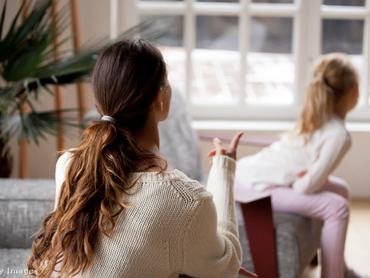
It can happen to any of us, and whilst this behaviour may even seem effective in the short term, in the long run it only reinforces the child’s belief that their parents are indeed insecure, desperate and helpless. Our displays of strength are, in fact, merely a pretence, which is completely meaningless to our children, who are far more sensitive to our inner feelings. Clarifying the balance of power should not be about our physical superiority, but about our inner, mental and emotional stability. It is about trusting ourselves and one another, trusting our decisions, and trusting in the merit and validity of the boundaries (rules) established on this basis.
Open communication and teamwork
Consistent parental confidence and consistency Of course, that would be an unrealistic expectation. We are constantly changing people living in a constantly and rapidly changing world. Parenthood is not a static state either. It is not a role that is hard-wired into us, or one that we learn once and can then perform with our eyes closed, but rather a dance that requires constant self-examination and self-regulation to ensure that our personal boundaries are compromised as little as possible. However, we will make mistakes, as we cannot protect either our children or ourselves from everything. That is precisely why, if we notice cheeky or even aggressive behaviour early on – similar to that seen in adolescence – we need not despair; we simply need to pluck up the courage to recognise the child’s signals and understand their meaning.
The thing is, what matters to children isn’t that their parents are perfect, but rather that they are honest. We often think that, as parents, we should know the right answer to everything, and that we have to deal with our own insecurities and challenges on our own. However, this is not true. If a problem involves several people, then a solution involving several people is also preferable. Open communication within the family is valued by everyone (partner, children), especially when we are able to express our own feelings and difficulties without judging or blaming others. Honest communication brings up a child for life. It sets an example of resilience in the face of failure, problem-solving, teamwork, acceptance of and respect for one another’s imperfections, and, last but not least, the importance of communication. In most cases, children are happy to take part in family discussions, as this also signals recognition of their competence. Boundaries established and clarified under our guidance but through a joint effort are also more readily respected by the child, as they have a better understanding of their significance, merit and validity, and know that these boundaries allow them to feel safe once again.
Originally published on: divany.hu, 27 August 2020.